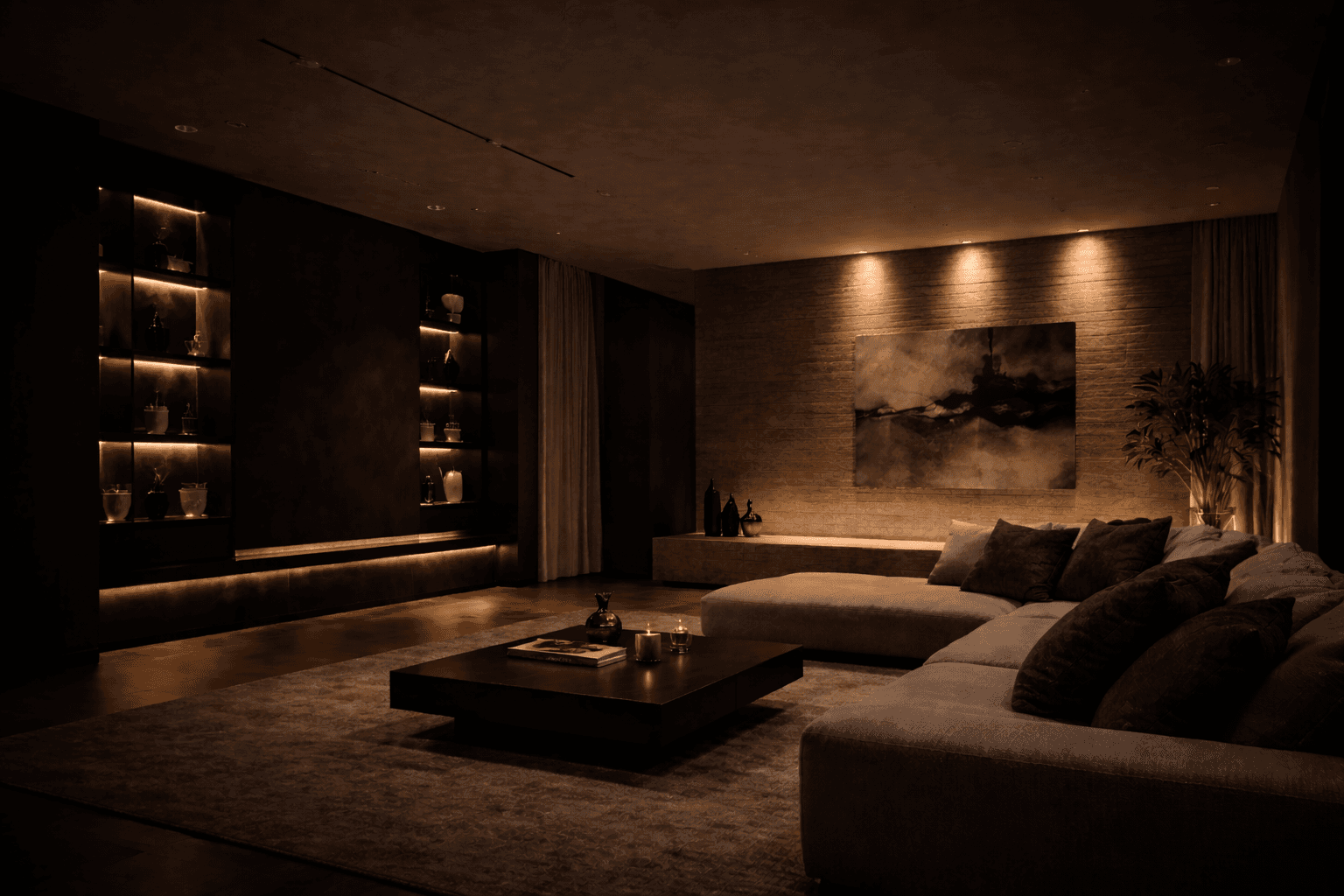
How light is born: a story that begins long before production

Many imagine that the production of a custom luminaire begins in the workshop – starting with metal, glass, or the first drawings. In reality, it all begins much earlier. At the moment when an architect, interior designer, or client asks a seemingly very simple question: "What if the light could be exactly like this?"
It is from that very thought that the entire creative process begins.
Every custom luminaire has its own story. Some are born from an architect's sketch, others – from a material that one wishes to transform into light. Sometimes the idea is dictated by the architecture itself, sometimes by the function of the space, and sometimes it all starts with a single detail, which eventually becomes the main accent of the entire interior.
Therefore, the first stage is almost never about production. It is about questions.
How will a person feel in this space?
Where will their gaze naturally wander?
What should the light emphasize, and what should remain in the shadows?
Will the luminaire become the main accent of the interior, or must the architecture remain the main protagonist?
These answers later determine dozens of technical solutions that the end user usually does not even notice.
Once the general direction is clear, the design phase begins. Proportions, construction, mounting methods, weight, materials, and possible production technologies are evaluated. At the same time, practical issues are resolved – how the luminaire will be installed, how it will be serviced after several years, how to hide power sources or control equipment so that the entire system remains not only aesthetic but also reliable.
However, even the most beautiful body does not yet guarantee good lighting.
Most of the work takes place where it cannot be seen.
LED modules, optics, color temperature, color rendering index (CRI), light distribution, control system, and power solutions are selected. Each of these elements affects how a person perceives the space. Sometimes it is enough to change the angle of the optics or the direction of the light to completely change the atmosphere of the interior, even though the luminaire itself remains the same.
For this reason, almost every project has a prototype phase. This is the moment when the idea first becomes a reality. Only then is it possible to evaluate whether the light behaves as intended. Do the surfaces reveal themselves naturally? Do the shadows create depth? Does the light glare? Do the selected materials look as expected?
It is precisely the prototype that usually becomes the project's most important teacher. Not because something was done incorrectly, but because light always behaves in real space, not on a computer screen.
Only after this stage does production begin.
Body processing, painting, glass manufacturing, electronics assembly, surface finishing, and final assembly take place sequentially, as every detail affects the final result. In the production of custom luminaires, there are no minor details. Even a tolerance of a few millimeters can change the direction of light, and an improperly selected surface finish can lead to a completely different reflection of light.
Before leaving for the project site, each luminaire is checked once again. It is evaluated not only for its functioning but also for how well it corresponds to the original idea. Because the final goal is not to manufacture a luminaire. The final goal is to create light that naturally blends into the architecture and looks as if it had always been there.
Perhaps that is why the best luminaires are usually not the ones we notice first. They are the ones that allow us to see the space itself.